
If you leave a ferment out with food below, too much head space and don’t touch it for a few days you will likely get a Kahm yeast growth on top. Kahm yeast is common in fermentation, but it can be easily managed and prevented given the right conditions.
Here is a simplified version of what to know about kahm yeast:
- What it is: kahm yeast is a group of oxidative yeasts that grow as a film on the surface of a ferment.
- How it differs from fermentation yeast: fermentation yeasts help make a ferment, while kahm yeast feeds on a ferment that is already made.
- Kahm yeast needs: oxygen availability, a still surface, and food from below (the acids and alcohol your ferment makes). Warmth speeds up grow.
- How to prevent kahm yeast: take away the oxygen availability by filling the jar which removes head space and interrupt the stagnation at the surface by stirring or touching. These are the two main techniques. Airlocks help with ferments that benefit from burping.
- When to watch most closely: the first few days, before your ferment has made enough acid to protect itself.
- What it does to your ferment: kahm yeast eats the acid in your ferment. This lets spoilage microbes move in and can ruin your ferment.
- How to remove it: skim it early, refresh the top of the brine if its too low, and then control the oxygen by using a correctly sized jar.
Read below for more.
What kahm yeast is
Kahm yeasts are oxidative yeasts (not fermentation yeasts), these yeasts are most commonly from the genera Candida, Pichia, and Debaryomyces, that grow on the surface of ferments [1].
Oxidative yeasts need oxygen to grow. This is why kahm yeast sits on top of your brine and climbs the walls of the jar, instead of growing down into the ferment.
How to recognize kahm yeast:
- A thin, matte or wrinkled film, sometimes bubbly
- White to cream in color
- It can climb the jar wall above the brine line
- It breaks apart into flakes when you touch it with a chopstick, instead of holding together as a sheet
- A yeasty, sour smell, sometimes described as cheesy
How to tell kahm yeast, a pellicle, and mold apart
| Kahm yeast | Pellicle (kombucha, vinegar) | Mold | |
|---|---|---|---|
| Texture | Thin, matte or wrinkled, sometimes bubbly | Smooth, rubbery, holds together as one sheet | Fuzzy, raised, visible filaments |
| Color | White to cream | Translucent to white or tan | Spots of green, black, blue, or pink |
| Where it grows | On the surface, and can climb the jar wall | On the surface, thickening evenly | In spots, not only on the surface |
| Chopstick test | Breaks into flakes and doesn’t come back together | Stays in one piece | Don’t touch it |
| Smell | Yeasty, sour, sometimes cheesy | Vinegary | Musty (don’t rely on smell alone) |
| What to do | Remove it early (see below) | Nothing, this is what you want | Throw the batch out |
How kahm yeast is different from fermentation yeast
Both are yeasts, but they live in different places in the jar and do opposite things to your ferment.
| Fermentative yeast | Kahm yeast (oxidative yeast) | |
|---|---|---|
| Examples | Saccharomyces in bread, wine, kombucha, and ginger bugs | Candida, Pichia, Debaryomyces |
| Needs oxygen to grow? | No, it can grow inside the liquid | Yes, so it grows only at the surface |
| What it eats | Sugar | The acids and alcohol your ferment has already made |
| What it makes | Alcohol and carbon dioxide (the bubbles) | Mostly carbon dioxide and water |
| Effect on your ferment | Builds flavor and fizz | Takes away the acid that protects it |
In short, fermentation yeasts are part of making a ferment, while kahm yeast feeds on a ferment that is already made [1].
What kahm yeast needs to grow
Kahm yeast needs three things at the same time:
- Oxygen at the surface: the air in the jar above your brine.
- A still surface: a surface that sits undisturbed long enough for a film to form.
- Food from below: your fermentation microbes eat the sugars in your food and make acids and alcohol, and kahm yeast then feeds on those acids and alcohol [1].
Warm temperatures speed all of this up.
The figure drawing below can also be found on my Kahm Yeast YouTube video. You can see steps 1-3 on how kahm develops. Oxygen comes down from the air above, acid comes up from the ferment below, and kahm yeast grows right where the two meet, at the surface (Figure 1). Take away the oxygen or the stillness, and the kahm can’t form.
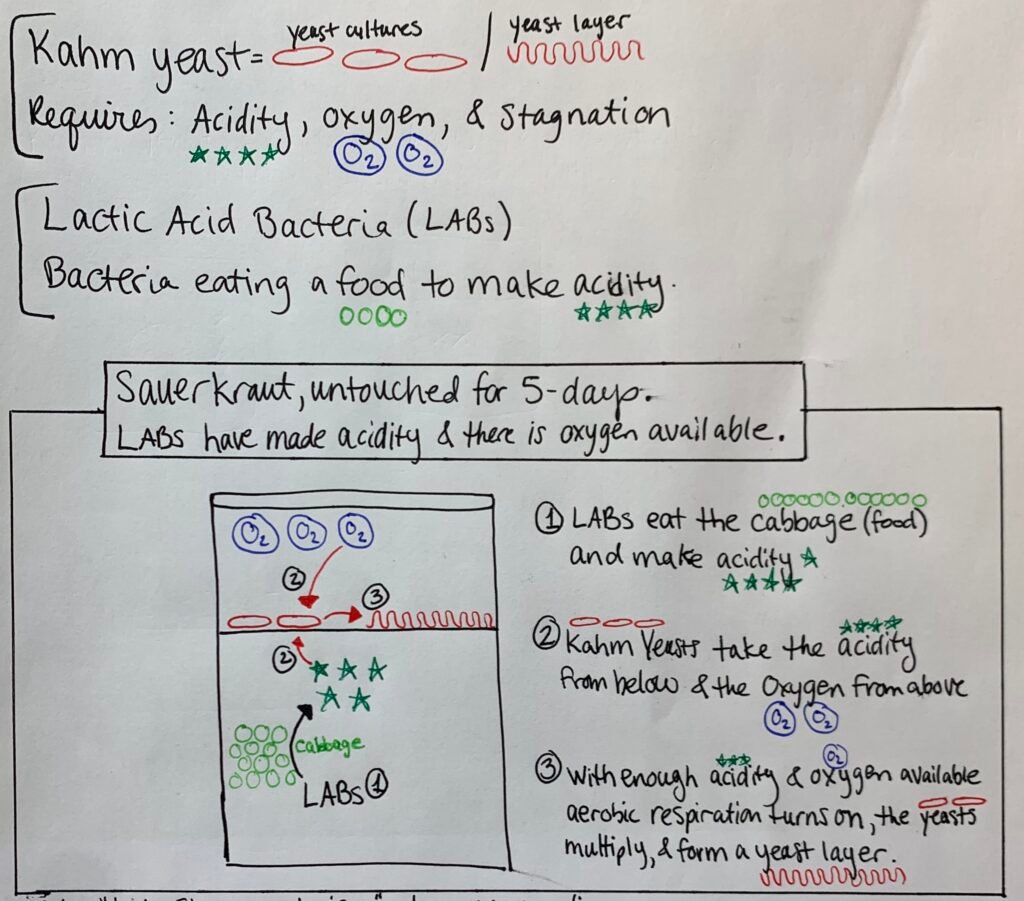
Figure 1
Salt won’t prevent kahm yeast on its own. Kahm-forming yeasts are salt tolerant, so the usual 2 to 5% salt doesn’t stop them [1]. What salt does is hold back other competitors while your lactic acid bacteria get to work, which helps your ferment become acidic faster.
How to prevent kahm yeast
You can’t take away the food, since the food is your ferment. So the way to prevent kahm yeast is to take away the oxygen, the stillness, or both.
Choose a jar that limits oxygen
- An airlock lid: lets carbon dioxide (CO2) out without letting air back in.
- A tight seal that you burp: a flip-top or screw-top jar, opened briefly to release pressure.
- A weight: keeps every piece of food under the brine.
Submerging the food protects the food itself, but it doesn’t protect the surface of the brine. The surface is still touching the air in the jar, which is why kahm yeast can show up on a ferment where everything is under the brine.
Keep the head space small
Head space is the air between the brine and the lid, and that air is exactly what kahm yeast needs. Fill your jar so there is as little head space as possible.
Head space also grows as you eat a ferment. Once a jar is half empty, move the ferment into a smaller jar [4], or press a food-safe bag filled with brine onto the surface so there is no air touching it.
Break up the stillness
Open the jar once a day, look at the surface, smell it, push anything that floated up back under the brine, and close it again. That daily visit disturbs the surface before a film can form. For loosely covered ferments like ginger bugs, water kefir, and fermented sodas, a daily stir does the same job.
Watch the first few days most closely
A fresh ferment hasn’t made much acid yet, so it is at its most fragile in the first few days. This is when kahm yeast and mold have the easiest time moving in. Once your ferment reaches a pH of 4.5 or lower, it is much better protected.
A low pH doesn’t make a ferment immune, though. Kahm yeast tolerates acid well and feeds on it, so a ferment that sits open and still can still grow kahm weeks later [1]. Acidity protects your ferment, and controlling oxygen at the surface is what keeps kahm yeast away.
Before refrigerators, people managed kahm yeast with routine: crocks were weighted and covered, kept cool once they had soured, and skimmed regularly. Extension guidance for home fermenters today still says to check the crock two to three times a week and remove any film that forms [7].
Kahm yeast by type of ferment
The advice changes a little depending on what you are fermenting.
- Vegetable ferments (sauerkraut, kimchi, pickles): the most common place for kahm yeast. Keep the food under the brine, keep the head space small, and use an airlock or a sealed jar you burp.
- Ginger bugs, water kefir, and fermented sodas: these are loosely covered on purpose, so stir daily. If you’ll be away, put the jar in the fridge until you can stir it again.
- Kombucha and vinegar: these need air, so you can’t seal them. Use a strong starter (at least 10 to 20% of the batch for kombucha) so the batch is acidic from day one, and use the chopstick test to tell kahm yeast from a young pellicle.
- Dairy ferments: kahm yeast is rare because a good starter acidifies milk quickly, but it can show up on longer-cultured products like crème fraîche.
- Olives: surface yeasts are an expected part of olive fermentation and contribute to their flavor and texture [5]. Keep an eye out for mold all the same.
Common kahm yeast tips, and whether they work
- Add more salt: no. Kahm-forming yeasts are salt tolerant, so extra salt won’t stop them [1]. Salt helps your ferment get acidic faster, and that’s all.
- Add grape or oak leaves: these help with crunch, not kahm yeast. Their tannins slow the enzymes that soften vegetables [6], but nothing suggests they stop a film from forming on the surface.
- Add a splash of vinegar or brine from an old batch: this helps a little. It lowers the pH from the start, which shortens the fragile first few days, but acid alone doesn’t stop kahm yeast.
- Move the jar to the fridge: this helps a lot once a ferment is sour. Cold slows kahm yeast down, but it doesn’t stop it completely, so keep the surface covered in the fridge too.
What kahm yeast does to the ferment below
The film itself is generally considered harmless [5]. The problem is what it does to the ferment underneath, and the pickle industry has studied this step by step in fermented cucumbers [1, 2]:
- Kahm yeast eats your acid. Using oxygen from the air, kahm yeasts break down the lactic acid (and acetic acid) your fermentation microbes made.
- The pH climbs. With less acid in the brine, the pH rises back toward the range your ferment worked to get out of.
- New microbes move in. Once the pH is high enough, other bacteria that couldn’t grow in the acidic brine can start growing below the surface. In the cucumber studies, these bacteria turned the remaining lactic acid into butyric and propionic acids, which smell like cheese or manure.
- The texture and flavor change. Excess yeast growth can leave a ferment soft, with off flavors, and less acidic [5].
So kahm yeast doesn’t spoil a ferment on its own. It removes the acid that was protecting the ferment, and that opens the door for the microbes that do.
Caution. If kahm yeast has been sitting on an older ferment, check the pH before eating it. If the pH has climbed back above 4.6, throw the batch out [3].
How to remove kahm yeast
Early kahm yeast, a thin film with no change in how the brine itself smells, can usually be saved.
- Lift the film off. A small turkey baster lifts it cleanly without breaking it into pieces that fall back into the brine. You can also slowly top up the jar with fresh brine until it overflows, so the film floats up and over the rim.
- Pour off the top few centimeters (an inch or two) of brine.
- Wipe the rim and the inside of the jar above the brine with a clean paper towel.
- Top up with fresh brine at the same salt percentage.
- Control the oxygen from here on: add an airlock, seal the jar and burp it, or open it daily until the pH is back under 4.5. Even then, keep the surface covered and the head space small.
The tipping point is when the smell or flavor has moved into the brine itself, not just the surface film, or when mold is growing through the kahm. At that point, throw the batch out.
Resources
- Watch the video: Kahm Yeast: What It Is and How to Prevent It
- Free Fermentation Logbook: six printable logbook pages and a look inside the guide. Get it here
- Fermentation Logbook & Guide: troubleshooting for all seven microbial groups, a side-by-side table of kahm yeast, pellicle, and mold, and the full kahm yeast and mold section. Get the guide here
References
- Franco W, Pérez-Díaz IM. Role of selected oxidative yeasts and bacteria in cucumber secondary fermentation associated with spoilage of the fermented fruit. Food Microbiology. 2012;32(2):338-344.
- Franco W, Pérez-Díaz IM, Johanningsmeier SD, McFeeters RF. Characteristics of spoilage-associated secondary cucumber fermentation. Applied and Environmental Microbiology. 2012;78(4):1273-1284.
- US Food and Drug Administration. Acidified Foods. Code of Federal Regulations, Title 21, Part 114.
- Katz SE. The Art of Fermentation. White River Junction, VT: Chelsea Green Publishing; 2012. pp. 103-104.
- University of California, Davis. Troubleshooting Fermented Fruits and Vegetables.
- Penn State Extension. Crispy Pickles.
- Washington State University Extension. Sauerkraut Making Directions.