
Oct 30, 2026 · by: Matthew Cress
This post has two sections:
- Section 1: For the person who wants to understand how chicken and other proteins are digested in the body, and how that impacts their health and digestion.
- Section 2: For the health professional who wants to help their patients, and for anyone else who wants the full mechanism.
Section 1: The chicken digestion essentials
Plain chicken is one of the most digestible proteins in the human diet. Cooked chicken is almost entirely broken down and absorbed in the small intestine: in a human study, about 92% of its essential amino acids were absorbed before reaching the colon [1]. That high absorbability makes chicken, and proteins like it, very interesting for anyone with a sensitive gut. On top of that, plain chicken breast has no carbohydrate and no fiber, so the gut microbes that ferment carbohydrate get nothing from it, so bloating from carbohydrate fermentation never happens.
Chicken digestion depends on two tools: stomach acid, which unfolds its proteins, and enzymes from the pancreas, which cut the proteins apart into small, absorbable amino acids. When those tools are working well, chicken is a gentle food. When they are weaker, more protein travels further down the gut, where bacteria ferment it, and the gas that comes from fermented protein tends to smell of sulfur.
The goal of this post is to show you what protein digestion should be doing, so you can recognize when yours is working well.
Who is this post for?
Anyone who relies on protein to feel strong and recover well. That includes two groups: people who find it hard to eat enough protein, and people who may not be digesting protein well. You’ll find this post useful if:
- You struggle to eat enough protein. Low appetite, fatigue (including conditions like ME/CFS), or recovery from illness or surgery can make protein hard to get in. A protein your body absorbs efficiently gives you the most for your effort.
- You’re an older adult wanting to keep your muscle. Muscle uses the amino acids from your meals to rebuild itself, so a well-absorbed protein works in your favor.
- You train to build or keep muscle. The same reasoning applies: the more of your protein that is absorbed, the more your muscles have to work with.
- You notice sulfur-smelling gas after protein meals. This can be a sign that protein is reaching gut bacteria instead of being absorbed.
- You take acid-lowering medication, or you’ve been told your pancreas isn’t producing enough enzymes. Both affect the tools protein digestion depends on. Talk with your doctor before making changes.
- You have SIBO or IBS and need a protein source with no fermentable carbohydrate.
Chicken, stop by stop
Here’s a simplified version of chicken digestion from start to finish (Figure 1):
- Cooking: heat unfolds the proteins so enzymes can reach them.
- Mouth: chewing breaks the meat fibers into small pieces. Saliva has no enzyme for protein.
- Stomach: stomach acid unfolds the proteins further and switches on pepsin, which starts cutting them into shorter chains.
- Duodenum: the pancreas adds protein-cutting enzymes, which do most of the work.
- Small intestine wall: brush border enzymes split the remaining short chains into single amino acids and chains of two or three, which are absorbed on the spot.
- Liver and blood: amino acids go to the liver first, then to your muscles and the rest of your body.
- Colon: in a healthy gut, only a small amount of protein reaches the colon.
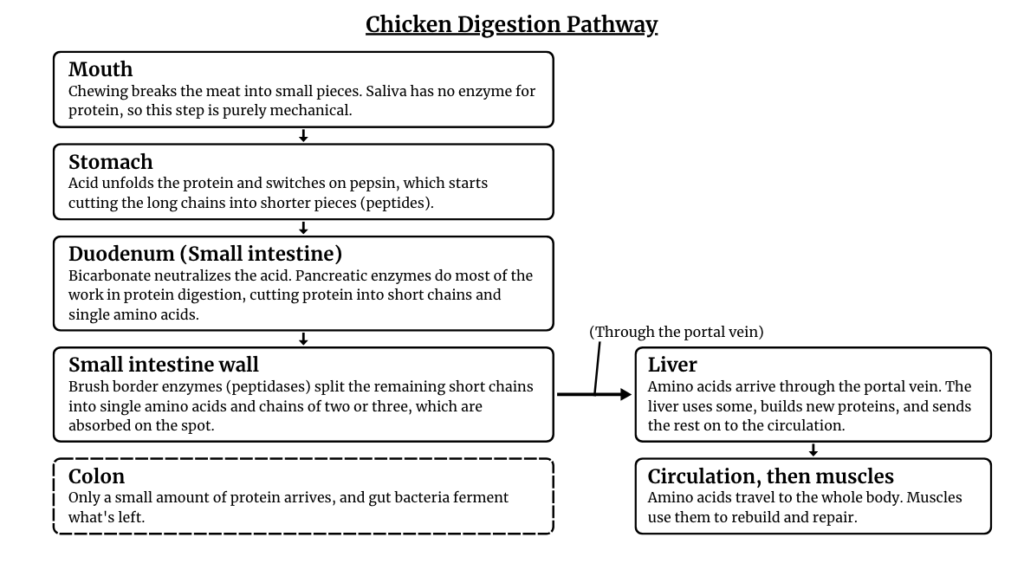
Figure 1. Chicken Digestion Pathway.
Why chicken is easy on your gut
Chicken works so well because almost all of it is absorbed before it reaches your gut bacteria. Three things make that happen:
- It’s absorbed almost completely. About nine-tenths of the protein in cooked chicken is absorbed in the small intestine [1].
- There’s nothing for carbohydrate fermenters. Plain chicken breast has no fiber, no starch, and no sugar.
- Your body gets there first. The last cuts and the absorption happen in the same spot on the wall of your small intestine, so very little is left floating around for microbes.
| Main idea: Chicken is absorbed almost completely in the small intestine, as long as stomach acid and pancreatic enzymes are doing their jobs. |
Matt’s Note: Plain, skinless chicken is one of my gold-standard foods for understanding the state of someone’s digestion. If they bloat off of plain chicken breast, then I’ll turn my attention to the digestive organs next for that person. If they don’t bloat, but other foods cause bloating, I’ll look into microbes and carbohydrate metabolism.
In complicated digestive cases, where there are often multiple symptoms happening all at once, it is incredibly helpful to rule out what is and isn’t causing those symptoms, so that the healing protocol can be intentional and methodical.
When protein digestion isn’t working
Signs that protein isn’t being fully digested:
- Heaviness or fullness that lingers for hours after a protein meal.
- Bloating after plain protein, even without carbohydrate.
- Gas that smells strongly of sulfur. (Also called ‘protein farts’)
- Stools that smell unusually foul, not just the gas is also a sign that protein isn’t being broken down enough in the body before exiting.
- Pieces of meat visible in your stool.
If you recognize these signs, keep a simple food and symptom log for a week or two: what you ate, when you ate it, and how you felt afterward. Then bring it to a professional, so the pattern is on paper instead of in your memory. If you’d like a ready-made log, I have a Food and Symptom Set: https://cressdietetics.com/product/food-and-symptom-set-health-tracking-worksheets/
See your doctor first if any of these come with greasy, pale, or floating stools, ongoing diarrhea, or weight loss you can’t explain.
How to use this at the table
- Choose plain, skinless chicken breast, cooked through but not dried out. Gentle cooking keeps protein the most digestible. In a human study with beef, meat cooked briefly at a lower temperature was slightly better absorbed than meat cooked long and hot: 94% compared with 90% [2].
- Chew it well. Meat fibers need more breaking down than rice, and the smaller the pieces, the less work your stomach has to do. Dice it up with a knife or shred it if need be.
- Try a food experiment: eat a plain portion of chicken on its own as your first meal of the day, and observe your digestion with curiosity over the next few hours. Comfortable digestion suggests your protein tools are working well. Heaviness, bloating, or sulfur-smelling gas is worth noting and discussing with a professional.
Caution. If you have kidney disease, talk with your doctor about how much protein is right for you before you increase it.
Matt’s Note: Gas that smells strongly of sulfur after protein meals tells me protein may be reaching gut bacteria instead of being absorbed. I look at the whole picture: how well the stomach and pancreas are doing their jobs, how fast food moves through, and whether bacteria are living too high in the small intestine. And if the gas comes with greasy, pale, or floating stools, ongoing diarrhea, or weight loss you can’t explain, see your doctor first. Those need medical testing before any diet change.
What about other proteins?
Cooked animal proteins are all very well digested, and the differences between beef, pork, fish, eggs, and dairy are small. Section 2 has the numbers. One thing makes a big difference, though: cooking. Cooked egg protein is about 91% absorbed, while raw egg protein is only about 51% absorbed [3]. So if you’ve been adding raw eggs to smoothies for protein, cooking them gets you far more.
Where to go from here
- Read the first post in this series: How Rice Is Digested.
- Sign up for updates: my meal plan guide is coming soon, and subscribers hear about it first. Contact: https://cressdietetics.com/contact/
- Visit the shop: guides and tracking worksheets at cressdietetics.com/shop.
- Work with me: if you’d like help figuring out what your gut needs, you can book a consultation.
- Keep reading for more in-depth detail on chicken (and other proteins) digestion.
Section 2: Going further for health professionals
This section walks through each stop in Figure 1 at full depth, with the enzymes, transporters, and evidence behind Section 1.
What chicken is made of
Per 100 g (3.5 oz) of roasted skinless breast, chicken provides about 31 g of protein and 3.6 g of fat, with no carbohydrate [4]. The protein sits in muscle fibers, which are long cells packed with the myofibrillar proteins actin and myosin (the contractile machinery), wrapped in connective tissue made mostly of collagen. Breast meat carries relatively little connective tissue, which is part of why it is tender.
A protein is a chain of amino acids joined by peptide bonds and folded into a three-dimensional shape. Digestion means hydrolyzing those bonds. Unlike starch, which must be cut all the way down to single glucose molecules, protein can be absorbed both as free amino acids and as di- and tripeptides (chains of two or three amino acids).
Denaturation. Heat unfolds proteins and exposes their peptide bonds to enzymes. The white of an egg turning opaque in the pan is denaturation you can see. Cooking is therefore a first digestive step: cooked egg protein reached about 91% true ileal digestibility in humans, against about 51% for raw egg [3]. Harsher cooking can promote protein aggregation and modestly reduce digestibility. In beef, true ileal digestibility was 94.1% after cooking at 55°C for 5 minutes and 90.1% after 90°C for 30 minutes [2].
Stop 1: the mouth
Saliva contains no protease of practical importance, so the mouth’s contribution is mechanical. Mastication reduces the meat to small particles and forms the bolus. This matters downstream, because the pylorus only passes small particles to the duodenum. Poorly chewed meat stays longer in the stomach for more grinding.
Stop 2: the stomach
The stomach plays a bigger part for protein than it does for starch. Parietal cells secrete hydrochloric acid, lowering gastric pH to about 1 to 2 (aka very acidic). The acid does two jobs: it denatures proteins further, and it converts pepsinogen, secreted by chief cells, into active pepsin. Pepsin then activates more pepsinogen, so the reaction speeds itself up.
Pepsin is an endopeptidase: it cuts bonds inside the chain, preferentially next to aromatic amino acids such as phenylalanine and tyrosine, producing large peptides. Pepsin handles only part of protein digestion, and the pancreatic proteases do most of the work [6]. The gastric phase still matters: in a laboratory study, protein that had been acidified and partly digested by pepsin was broken down by trypsin far more efficiently than protein that bypassed the stomach [5]. The stomach prepares protein; it doesn’t finish it.
| Main idea: Stomach acid prepares protein, and the pancreas does most of the work. Protein maldigestion becomes likely when more than one step is weak. |
Matt’s Note: When a client reports heaviness or sulfur-smelling gas after protein, I start with stomach acid because it sets up everything downstream. I don’t stop there, though, since the pancreas can largely make up for a weaker stomach. I check whether more than one step is struggling:
- Acid: acid-lowering medication, age, or a history of reflux treatment.
- Enzymes: signs of low pancreatic output, such as greasy or floating stools.
- Transit: food moving through too fast to be fully digested.
- Bacteria: overgrowth in the small intestine competing for what’s there.
Stop 3: the duodenum
Most protein digestion happens here. Acid entering the duodenum triggers secretin, which drives pancreatic bicarbonate secretion and brings the chyme to a near-neutral pH. Peptides, amino acids, and fat in the chyme trigger cholecystokinin (CCK), which drives pancreatic enzyme secretion [6]. Carbohydrate is a weak CCK trigger, while protein and fat are strong ones, so a chicken meal stimulates CCK strongly.
The pancreas secretes its proteases as inactive precursors called zymogens (aka safety locks, so the pancreas doesn’t digest itself): trypsinogen, chymotrypsinogen, proelastase, and the procarboxypeptidases. Enteropeptidase, an enzyme on the duodenal brush border, converts trypsinogen into trypsin, and trypsin then activates all the others in a cascade [6].
The proteases work as a team:
- Endopeptidases (trypsin, chymotrypsin, elastase) cut bonds inside the chain, each at different amino acids.
- Exopeptidases (carboxypeptidases A and B) remove amino acids one at a time from the end of the chain.
The result is a mixture of free amino acids and short peptides, ready for the final stage at the intestinal wall.
Stop 4: the brush border
Final hydrolysis and absorption happen together at the brush border, a surface folded into villi and microvilli that multiplies the absorptive area many times over. Aminopeptidases and dipeptidases anchored in the membrane trim the remaining peptides [6]. What crosses into the enterocyte then takes two routes:
- Free amino acids enter through several transporters, each handling a different class of amino acids, many of them sodium-dependent.
- Di- and tripeptides enter through PepT1, a proton-coupled, high-capacity transporter that recognizes thousands of different di- and tripeptides [7].
Inside the enterocyte, cytosolic peptidases split the absorbed peptides into free amino acids, which leave through basolateral transporters into the portal blood. The enterocytes also keep some amino acids for their own fuel and renewal, since the gut lining is one of the fastest-renewing tissues in the body.
| Main idea: Protein can be absorbed as single amino acids or as chains of two or three, so the small intestine captures it quickly and leaves little for microbes. |
Stop 5: the colon
Because cooked meat protein is roughly 90 to 95% digested in the small intestine, only a small share of dietary protein reaches the colon. It isn’t alone there. Digestive enzymes, mucus, and shed cells from the gut lining are protein too. Between dietary and the body’s own protein, an estimated 12 to 18 g reach the colon each day [8].
Colonic bacteria ferment this protein mainly in the distal colon, producing ammonia, hydrogen sulfide (from the sulfur-containing amino acids), phenols, indoles, amines, and branched-chain fatty acids [8, 9]. How much reaches the colon depends on digestibility. When healthy volunteers ate raw egg protein, about 35% escaped small intestinal digestion, compared with about 6% for cooked egg, and more fermentation byproducts were recovered in their urine [10].
The surrounding diet shapes this fermentation. Fiber and resistant starch give colonic bacteria carbohydrate to ferment instead, and adding them reduces markers of protein fermentation [9]. The evidence has limits worth stating plainly: one review describes the clinical relevance of excess protein fermentation for IBS and malodorous flatus as underexplored [9].
Hydrogen sulfide. Breath testing now distinguishes three overgrowth patterns: hydrogen-predominant SIBO, intestinal methanogen overgrowth (IMO), and intestinal sulfide overproduction (ISO), with ISO supported by a breath hydrogen sulfide level of 2 ppm or higher [11]. Whether dietary protein drives ISO hasn’t been established.
Matt’s Note: I treat sulfur-smelling gas as a digestion clue, not a diagnosis. For a client who already struggles to eat enough protein, cutting protein is rarely my first move. I would rather improve how protein is digested, through better chewing, gentler cooking, meal spacing, and support for the steps upstream, and pair it with foods that feed the colon well.
After absorption: amino acids
Absorbed amino acids drain through the portal vein to the liver, and the splanchnic tissues (the gut and liver) use a large share first. In a study of 20 g of protein in healthy young men, about 55% of the protein-derived amino acids appeared in the circulation over 5 hours. About 20% of those were taken up by skeletal muscle, where they stimulated muscle protein synthesis [12].
The liver acts as a sorting center for the rest. It builds plasma proteins such as albumin, uses amino acids for energy or to make glucose, and removes their nitrogen as urea. In the beef study, about 21% of the ingested nitrogen was deaminated within 8 hours [2].
| Main idea: The gut and liver use a large share of absorbed amino acids first, and muscle receives a smaller portion that drives muscle protein synthesis. |
Side note: other proteins compared
Cooked animal proteins cluster at the top of the digestibility range. Methods differ between studies, so small differences shouldn’t be over-read.
| Protein | True ileal digestibility in humans | Source |
|---|---|---|
| Milk protein | 95.5% | [13] |
| Beef, cooked gently (55°C, 5 min) | 94.1% | [2] |
| Beef, cooked long and hot (90°C, 30 min) | 90.1% | [2] |
| Chicken, pressure-cooked (essential amino acids) | 92.0% | [1] |
| Egg, cooked | 90.9% | [3] |
| Egg, raw | 51.3% | [3] |
| Pork and fish | Few human ileal measurements |
The clinical takeaway: for a patient struggling to meet protein needs, the choice among cooked animal proteins matters less than cooking them, chewing them well, and supporting the digestive steps upstream. A future post will compare proteins in depth, including plant proteins.
Working together
If you’re a dietitian, doctor, or other health professional with patients who have complex, long-running digestive conditions, or who struggle to meet their protein needs, I welcome referrals and questions. You can reach me through my contact page.
References
- Kashyap S, Shivakumar N, Varkey A, Duraisamy R, Thomas T, Preston T, Devi S, Kurpad AV. Ileal digestibility of intrinsically labeled hen’s egg and meat protein determined with the dual stable isotope tracer method in Indian adults. Am J Clin Nutr. 2018;108(5):980-987. Link
- Oberli M, et al. High true ileal digestibility but not postprandial utilization of nitrogen from bovine meat protein in humans is moderately decreased by high-temperature, long-duration cooking. J Nutr. 2015;145(10):2221-2228. Link
- Evenepoel P, Geypens B, Luypaerts A, Hiele M, Ghoos Y, Rutgeerts P. Digestibility of cooked and raw egg protein in humans as assessed by stable isotope techniques. J Nutr. 1998;128(10):1716-1722. Link
- U.S. Department of Agriculture. FoodData Central: chicken, broilers or fryers, breast, meat only, cooked, roasted. Link
- Rivera del Rio A, Keppler JK, Boom RM, Janssen AEM. Protein acidification and hydrolysis by pepsin ensure efficient trypsin-catalyzed hydrolysis. Food Funct. 2021;12(10):4570-4581. Link
- Goodman BE. Insights into digestion and absorption of major nutrients in humans. Adv Physiol Educ. 2010;34(2):44-53.
- Wang CY, Liu S, Xie XN, Tan ZR. Regulation profile of the intestinal peptide transporter 1 (PepT1). Drug Des Devel Ther. 2017;11:3511-3517. Link
- Davila AM, et al. Intestinal luminal nitrogen metabolism: role of the gut microbiota and consequences for the host. Pharmacol Res. 2013;68(1):95-107.
- Yao CK, Muir JG, Gibson PR. Review article: insights into colonic protein fermentation, its modulation and potential health implications. Aliment Pharmacol Ther. 2016;43(2):181-196. Link
- Evenepoel P, Claus D, Geypens B, et al. Amount and fate of egg protein escaping assimilation in the small intestine of humans. Am J Physiol. 1999;277(5):G935-G943.
- de Freitas Germano J, Leite G, Pimentel M. Do multi-omics approaches improve the diagnosis of microbial overgrowth syndromes? Curr Gastroenterol Rep. 2026. doi:10.1007/s11894-026-01057-y. Link
- Groen BBL, Horstman AM, Hamer HM, et al. Post-prandial protein handling: you are what you just ate. PLoS One. 2015;10(11):e0141582. Link
- Bos C, Mahé S, Gaudichon C, et al. Assessment of net postprandial protein utilization of 15N-labelled milk nitrogen in human subjects. Br J Nutr. 1999. Link