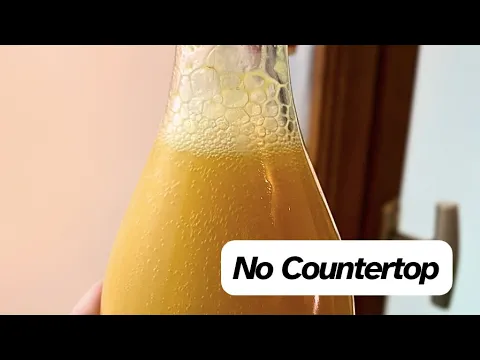
A Low-Maintenance Ginger Bug System (Without a Daily Countertop Jar)
How to maintain a ginger bug without daily feedings. Matt's method.
GINGER BUGFERMENTATION
12/29/20253 min read
A Low-Maintenance Ginger Bug System (Without a Daily Countertop Jar)
Active ginger bugs that live on the countertop make for beautiful yeasted ferments but their constant need for attention often causes people to lose interest. I’ve fixed this problem with my cold-start live yeast starter.
Traditional ginger bugs are often kept active on the countertop, fed daily with sugar and fresh ginger. While this can produce strong fermentation, it also creates a level of upkeep and commitment that many people end up abandoning over time. Miss a few days, and the bug weakens or simply dies. Feed inconsistently, and it becomes unpredictable.
How can we keep having yeasted ferments without needing to take care of a bug on a daily basis?
I figured out how to have no daily feedings while keeping an active culture.
The core idea: a fridge-stable seed culture
Instead of maintaining a live ginger bug on my countertop, I now keep an active ginger soda in the refrigerator and use it as a seed culture whenever I want to ferment something new. You do not need a ginger bug for this, any live wild yeast bug will work. I’ve done this with a ginger bug, apple bug, a multi-fruit juice bug, and an apricot bug.
Matt’s Note: I do think that if you were to do this wild bug with a grain like rice, oats, or wheat grains, you would still be able to do a fruit soda out of it but it might just take longer on the countertop to fully ferment.
This cold fridge soda yeast seed is not dormant. Refrigeration slows microbial metabolism, but it does not eliminate microbial viability. Yeasts and lactic acid bacteria remain alive, simply operating at a lower metabolic rate. When reintroduced to warmth and fresh sugars, they resume fermentation reliably.
In practice, this functions similarly to other traditional methods of back-slopping or culture retention:
Using whey from yogurt to start the next batch
Using finished kombucha to seed fresh tea
Retaining sourdough starter between bakes
The difference is that this system removes daily maintenance and replaces it with intentional reactivation.
Why this works microbiologically
Wild yeast and lactic acid bacteria are resilient organisms. They are designed to survive fluctuating environments, including temperature shifts and periods of reduced activity.
In a refrigerated ginger soda:
Sugar remains available
Acidity provides a stable environment
Microbial populations persist at low activity
When this liquid is removed from the fridge and combined with fresh sugar, ginger (or other plants), and warmth, fermentation resumes with a predictable lag phase followed by visible activity.
This approach shifts the fermentation model from constant stimulation to periodic activation, which is often more sustainable long-term.
What this system does well (and what it doesn’t)
This method excels at:
Reducing daily feeding pressure
Improving consistency over time
Supporting spontaneous fermentation projects
Lowering the chance of burnout or abandonment
There are also trade-offs worth understanding.
Then, as you make new sodas, you simply replace the older seed soda with a new one which keeps your yeast ferment continuously renewed.
Matt’s Note: This technique helps me make a soda once a week to once every six weeks. Truly, I can make sodas as I see fit and I’m not a slave to keeping my ginger bug alive.
Seeing the system in action
To demonstrate this approach in practice, I used my refrigerator-stable apple cinnamon soda as a ‘cold seed ginger bug’ to make a fresh orange soda. The fermentation proceeded normally, produced visible carbonation, and behaved exactly as expected once chilled. The ferment maybe took slightly longer to carbonate, but this is a non-issue.
I’ve embedded my video below for those who want to see what this looks like visually, including carbonation development and a final taste test.
The Lowest-Maintenance Ginger Bug System (Proven with Orange Soda)
The purpose of this demonstration isn’t the orange soda recipe itself. It’s to show that a low-maintenance, chilled, live-yeast system can still deliver reliable results.
Who this approach is best suited for
This system works particularly well for:
People who ferment intermittently
Those who dislike daily feeding routines
Anyone managing multiple fermentation projects
A traditional countertop ginger bug can still be a powerful tool. This is not a rejection of that method, but an alternative for those seeking flexibility and longevity
Final thoughts
Fermentation systems evolve. As experience grows, so does the desire for methods that are robust, forgiving, and repeatable.
A system that gets used consistently is more valuable than one that is theoretically perfect but practically exhausting.
This refrigerator-stable ginger bug system has allowed me to continue working with wild ferments without daily friction, while maintaining confidence in the results. For many people, that shift alone makes fermentation sustainable again.
Matt's Video: The Lowest-Maintenance Ginger Bug System (Proven with Orange Soda)